

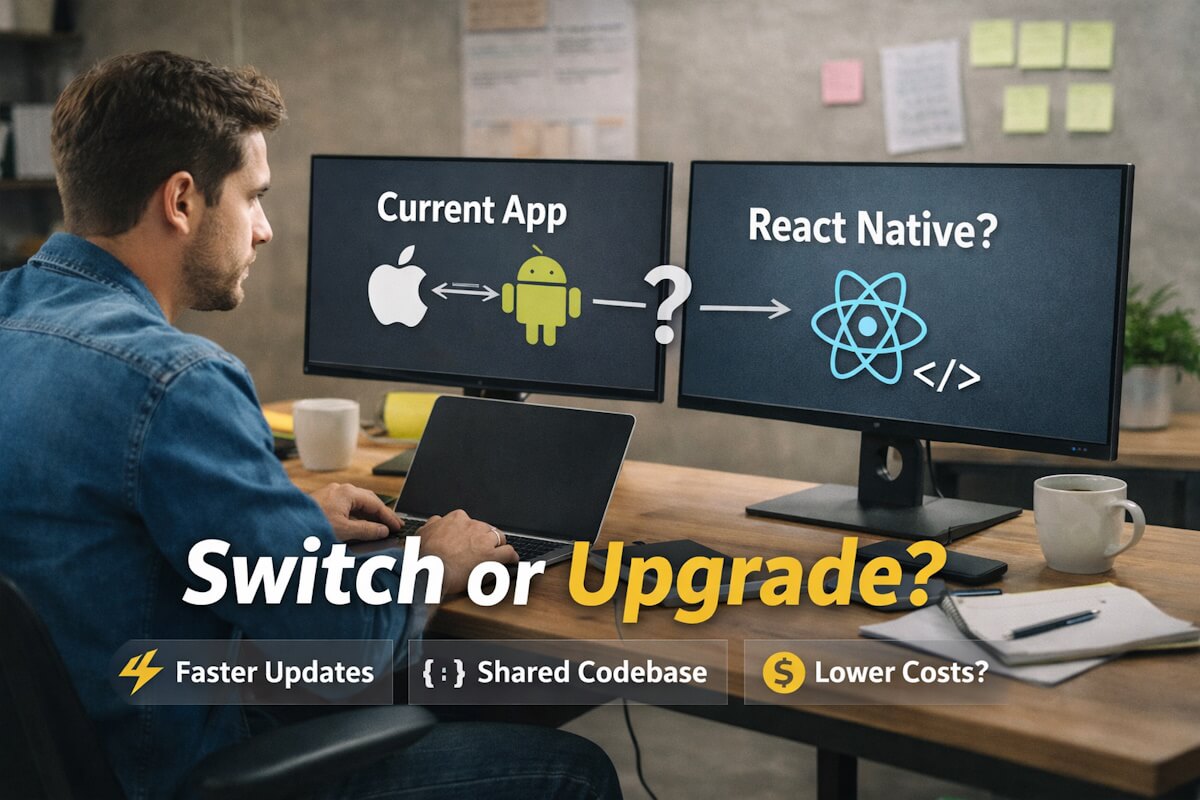
You’ve already got an app. It works. People use it. Maybe it’s built in native iOS and Android. Maybe it’s getting harder to maintain. Updates feel slow. Costs keep stacking up.
So now you’re wondering… can React Native actually replace what you already have?
Short answer? Yes, it can.
Long answer? It depends on how your current app is built, what you expect going forward, and how much change you’re ready to handle.
Let’s break this down in a way that actually helps you decide.
What Does “Replacing Your Existing App” Really Mean?
Before jumping into tools or frameworks, let’s clear something up.
Replacing an app doesn’t always mean throwing everything away and starting fresh.
You’ve got a few paths:
- Full rewrite using React Native
- Gradual migration, feature by feature
- Hybrid approach where some parts stay native
Each option comes with trade-offs. And yeah, none of them are completely painless.
But here’s the thing. If your current app is slowing your team down, you’re already paying a cost. Just not the obvious one.
Why Businesses Even Consider React Native
You don’t wake up one day and randomly decide to rebuild your app.
There’s usually friction.
Here’s what pushes teams toward React Native:
Development Feels Too Slow
Maintaining two separate codebases for iOS and Android gets exhausting. Every feature needs to be built twice. Every bug needs double fixing.
That’s where React Native changes the game. You write most of the code once and reuse it across platforms.
Less repetition. Faster releases.
Costs Keep Creeping Up
More developers. More hours. More overhead.
When you switch to a shared codebase, the team size can shrink or at least become more focused.
That’s one big reason companies look for React Native App Development Services. They want to cut waste without cutting quality.
You Need Faster Updates
Users expect quick improvements. Waiting weeks for updates to roll out across platforms just doesn’t cut it anymore.
React Native allows quicker iteration cycles. You can push updates faster and test ideas without dragging the process.
Can React Native Match Native Performance?
This is usually the first concern.
And fair enough.
Nobody wants a laggy app.
Here’s the honest take:
- For most apps, React Native performs really well
- For heavy graphics or high-performance gaming, native still wins
- For business apps, marketplaces, social apps, dashboards… React Native works just fine
You won’t notice much difference unless your app relies heavily on device-level processing or advanced animations.
And even then, you can still write native modules where needed.
So it’s not all or nothing.
When Replacing Your App Makes Sense
Let’s get practical. Not every app should be rebuilt.
But in these cases, it usually makes sense:
Your Codebase Is Getting Messy
If your current app feels like a patchwork of fixes, rebuilding might actually save time long term.
Constant bug fixing is a sign something deeper is off.
You’re Scaling Fast
More users. More features. More pressure.
A clean React Native setup can make scaling easier, especially when your team needs to move fast.
You Want One Team Instead of Two
Managing separate iOS and Android teams isn’t always efficient.
With React Native, you can unify your workflow. That’s why many companies choose to Hire React Native Developers instead of maintaining multiple specialized teams.
Your App Needs Frequent Updates
If you’re pushing updates often, React Native helps reduce friction.
Less waiting. Less duplication.
When You Should Think Twice
Let’s not pretend React Native is perfect.
There are cases where sticking to native makes more sense.
Your App Is Performance Heavy
If you’re building something like:
- High-end games
- AR or VR experiences
- Complex real-time systems
Native development is still the safer bet.
You Rely Deeply on Native APIs
Some apps depend heavily on platform-specific features.
While React Native supports many APIs, edge cases can get tricky.
Your Current App Works Perfectly Fine
If your app is stable, scalable, and not causing issues, rebuilding might not be worth it.
Sometimes the best move is no move.
Full Rewrite vs Gradual Migration
Now here’s a big decision.
Do you rebuild everything at once or transition slowly?
Full Rewrite
Pros:
- Clean start
- Better architecture
- No legacy issues
Cons:
- Time-consuming
- Higher upfront cost
- Risk of delays
Gradual Migration
Pros:
- Lower risk
- Easier to manage
- You can test as you go
Cons:
- Temporary complexity
- Mixed tech stack
A lot of businesses prefer gradual migration. It gives you breathing room.
You don’t have to bet everything at once.
What Happens to Your Existing Features?
Good question.
You don’t lose them.
You rebuild or reuse them depending on the approach.
Some logic can be reused. Some parts need rewriting. UI usually gets rebuilt.
It’s not copy-paste. But it’s also not starting from zero.
The Real Cost of Switching
Let’s talk money. Because that’s always part of the decision.
Switching to React Native involves:
- Development cost
- Testing and QA
- Possible redesign
- Time investment
But here’s what often gets missed:
The cost of staying where you are.
- Slower updates
- Higher maintenance
- Team inefficiency
Over time, those costs add up.
That’s why many companies see this as a long-term move rather than a quick fix.
How Long Does It Take?
There’s no fixed answer, but here’s a rough idea:
- Small apps: a few weeks to a couple of months
- Medium apps: 2 to 4 months
- Large apps: 4 to 6+ months
It depends on complexity, team size, and approach.
Gradual migration can stretch longer but feels less risky.
What About User Experience?
Users don’t care what tech you use.
They care about:
- Speed
- Stability
- Ease of use
If done right, React Native apps feel just as smooth.
In many cases, users won’t even notice the change.
That’s actually the goal.
Common Mistakes to Avoid
If you’re thinking about switching, watch out for these:
Rushing the Decision
Don’t jump just because it sounds trendy.
Look at your actual problems first.
Ignoring App Architecture
A messy rebuild leads to the same problems again.
Plan your structure properly.
Choosing the Wrong Team
This matters a lot.
Experienced teams offering React Native App Development Services know how to handle edge cases, performance tuning, and clean architecture.
Cutting corners here can cost more later.
Expecting Instant Results
Rebuilding takes time.
You won’t see results overnight.
How to Decide If React Native Is Right for You
Ask yourself:
- Is my current app slowing down my team?
- Are maintenance costs getting too high?
- Do I need faster updates?
- Can I benefit from a shared codebase?
If you’re nodding yes to most of these, React Native is worth considering.
If not, you might be better off improving what you already have.
A Smarter Way Forward
You don’t have to go all in right away.
Start small.
- Build a new feature in React Native
- Test performance
- See how your team adapts
This gives you real insight without heavy risk.
From there, you can decide your next move.
So, Can React Native Replace Your App?
Yes, it can.
But the better question is… should it?
For many businesses, the answer is yes because it reduces duplication, speeds up development, and simplifies team structure.
For others, sticking with native still makes sense.
It comes down to your goals, your current setup, and how much change you’re ready to handle.
If you’re already feeling friction with your existing app, ignoring it won’t help.
At some point, you’ll need to decide.
Rebuild. Improve. Or stay where you are.
What’s it going to be for you?